
I was almost asleep when I heard someone moving the furniture downstairs. It sounded as though they were dragging heavy chairs across the parquet in the dining room, which was strange, given that I hadn’t lived in a house with a dining room for nearly fifteen years. I opened one eye and looked up. The ceiling above me was high and covered in faint, water-stained plaster patterns I didn’t recognise, but that was hardly unusual anymore. I closed my eye again and waited for the house to quiet down.
Somewhere deeper in the dark, a clock struck thirteen. I had always disliked that clock. It had no sense of pacing and never seemed to know when a day was actually finished.
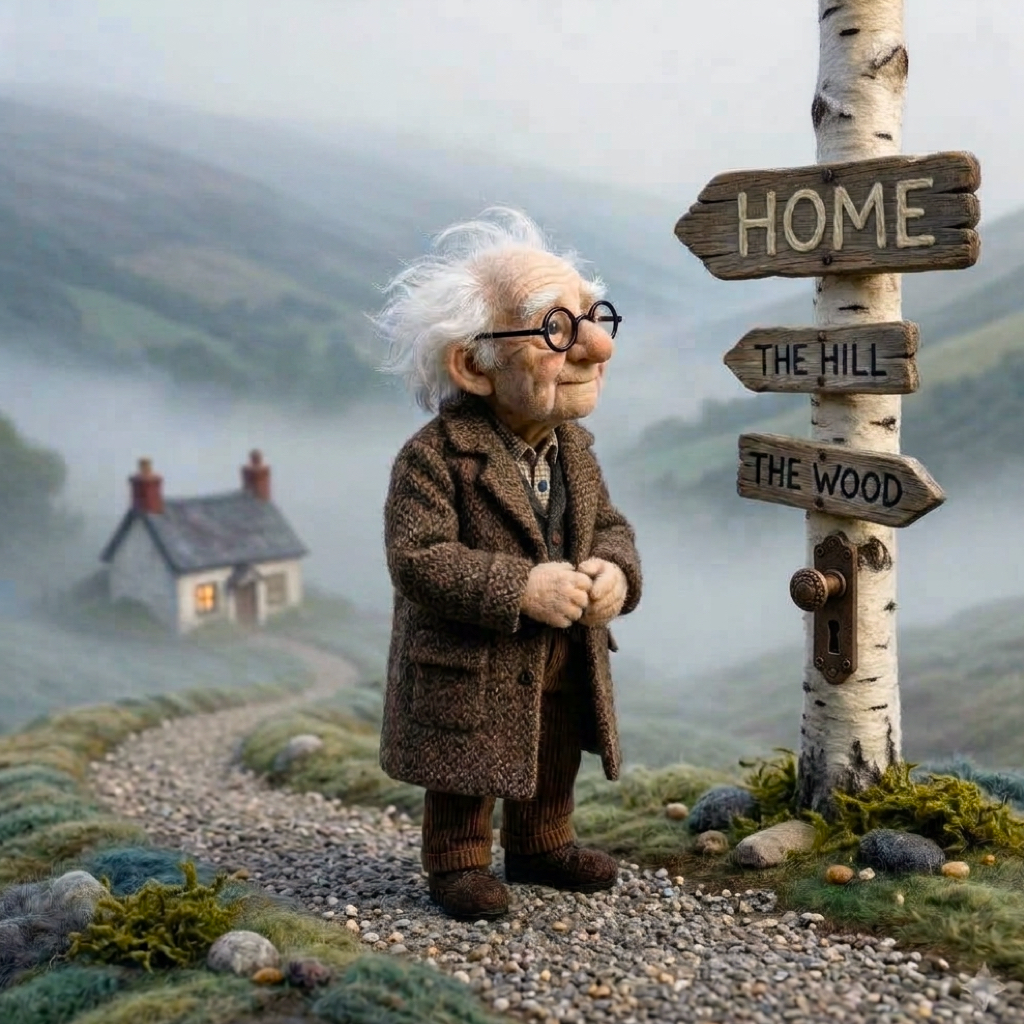
When I opened my eyes again, the room was gone. I was standing beside a narrow dirt road in my slippers, the hems of my trousers damp with morning dew. A wooden signpost stood tilted in the tall grass at the shoulder, pointing towards a small, white-boarded house nestled in the valley below. HOME, it said in chipped black paint.
I checked my pockets to see what I had brought with me. There was a brass door key, three cool copper coins, and a scrap of torn paper with my name written across the middle in a neat, unfamiliar script. On the reverse side, someone had scribbled a single sentence in pencil: If you lived here, you’d be home already.
I read it twice, then slipped it back into my coat. The road ahead looked considerably longer than it had a moment before, but the wind was coming up cold behind me, so I started walking.
Birch trees lined the edges of the track, their leaves turning pale in the low light. I felt a quiet wave of recognition as I passed them, as though I had climbed through these exact branches decades ago, though I couldn’t have named the forest. A wooden swing hung motionless from one low bough, its rope weathered grey. A few paces further on, another birch had a small iron door handle set directly into the pale bark of its trunk. I paused and turned the handle. It was locked tight. I reached into my pocket, felt the cold weight of the brass key against my knuckles, and decided against it. Some doors are better left alone until morning.
A woman approached from the opposite direction, walking with a slow, deliberate stride and carrying a wide porcelain bowl in both hands.
“Excuse me,” I said, stepping slightly off the path. “Can you tell me where this road leads?”
She stopped, looking past my shoulder as if listening for something further down the hill. “Not yet,” she said gently.
She continued past me without another word. As she went, I glanced down into the bowl she held so carefully. It was completely empty.
Before I could turn to ask what she meant, the cold air vanished, and I found myself standing on the linoleum floor of my childhood kitchen. The smell of boiled tea and old, damp coal filled the room. My mother stood at the enamel sink with her back to me, her hair pinned up the way she used to wear it, though her shoulders were straight and her hands unlined. She looked much younger than I was now.
“Have you seen my shoes?” I asked. My voice sounded strangely small in the quiet room.
She didn’t turn around, but pointed a wet hand towards the back door.
I looked down at my feet. “Not these,” I said, lifting the toe of a slipper.
She turned off the brass tap and let the water settle in the basin. “Then you haven’t lost them yet, have you?”
I didn’t know how to answer that, so I turned towards the window above the sink. Out in the middle of the back field, miles away from where it belonged, stood the white house from the road. I had never seen it from this side before.
“Is that our house?” I asked, leaning closer to the glass.
My mother leaned forward and looked out into the grey light of the yard. “Which one?”
When I turned to point it out to her, the kitchen was gone.
I was standing ankle-deep in the long grass of the field. The house was much closer now, its lower windows glowing with warm, amber light in the gathering dusk. A thin thread of blue smoke drifted straight up from the brick chimney, perfectly vertical, as if there were no wind in the world to disturb it.
I crossed the grass towards the porch. Sitting beside the doorstep was a pair of old leather work shoes. I knew them instantly by the small, ragged hole worn through the outer edge of the right sole—a hole I had scraped into the leather on a sharp rock when I was nine years old. I picked them up. They were still warm, as if someone had just stepped out of them.
Before I could knock, the front door unlatched itself and swung inward with a soft click.
Inside was a small, quiet room that I almost remembered: a stone hearth, two deep armchairs, and a low oak table holding a steaming cup of dark tea. Beside the cup lay an open book, but whenever I tried to settle my eyes on the printed lines, the words blurred and shifted across the page like water.
I sat down in the chair by the hearth. The cushion yielded to my weight so naturally that I was struck by the curious feeling that I had been sitting in that exact spot for years, simply waiting for someone to come home. Perhaps I had.
On the mantelpiece above the cold grate stood a framed photograph. It showed the very room I was sitting in, except that in the picture, a figure stood by the window holding a cardboard sign that read HOME. I turned to look at the window, but the glass reflected only my own shadow sitting in the chair.
I reached out, picked up the cup, and drank. The tea had gone lukewarm, but it tasted faintly of tin and dried mint—a taste I hadn’t thought about in half a lifetime.
Pipes knocked softly within the walls. Upstairs, floorboards creaked under the weight of light, pacing steps, and somewhere deeper in the house, a woman laughed quietly. I started to stand up to call out to her, but then I remembered that the house had no upper storey—there was only the roof and the sky above it. I looked up at the ceiling. It was the same plain, water-stained plaster I had stared at when I first woke up that morning.
I set the cup down and walked out into the yard.
The grass was gone, replaced by a deep blanket of untrodden snow that muffled the world into silence. A blackbird perched on the wooden gate, its dark eyes watching me as I approached.
“Am I home yet?” I asked the bird.
It tilted its head, considering the snow. “Are you?”
Beyond the gate, the snow gave way to a vast, grey beach. The sea was completely flat, stretched out like a sheet of dark slate beneath the pale sky. A little boy stood near the water’s edge in a wool coat, holding a folded paper boat. He moved with a measured, deliberate precision—a slow, quiet cadence that felt unhurried and mechanical, like the steady swing of a pendulum.
“Have you lost something?” he asked without looking up.
“I don’t think so,” I said.
He nodded, as if I had confirmed a long-standing suspicion, and carefully set the paper boat onto the foam. It didn’t drift or bob; it simply sat upon the water while a quiet, metallic ticking sound began to rise beneath the tide.
One. Two. Three.
When I looked again, the boy was no longer there. In his place stood an old man wrapped in my heavy brown overcoat, gazing out towards the receding horizon where the paper boat sat perfectly still.
“Do you know the way back?” I asked him.
He shrugged, pulling the collar tighter against his neck. “I used to.”
“What happened?”
He looked down at the worn wool of the sleeves. “I got here.”
The ticking sound echoed once more across the water—deep, slow, and familiar. The thirteenth stroke.
I closed my eyes against the sound, and when I opened them, I was sitting back in the armchair beside the hearth. The tea on the table was steaming hot again. The photograph on the mantelpiece had vanished, and in its place lay a folded slip of paper with four words written across it: Back in a moment.
I sat in the dimming light and waited while the embers in the grate turned to soft grey ash. Outside, a heavy latch lifted. Footsteps crossed the snow in the garden, and then I heard the distinct sound of someone climbing a flight of wooden stairs that didn’t exist. A voice spoke my name, so close to my ear that I felt the faint brush of air against my neck.
I wanted to answer, but my eyelids felt impossibly heavy, weighted down by the familiar comfort of the room. I could feel the soft pressure of a mattress beneath my back now, the familiar weight of a wool blanket pulled up to my chin, and the steady, domestic hum of a house with ordinary ceilings and clocks that kept proper time.
The light in the room shifted, growing brighter—or perhaps darker. It was impossible to say.
When I opened my eyes, I was standing back on the dirt road in my slippers. The wooden signpost was still there, its painted arrow pointing directly at my chest: HOME.
I reached into my pocket and pulled out the piece of paper. Beneath the handwriting I knew, a new line had been added in faint, fresh ink: You don’t have to find your way here. You already know it.
In the valley below, the white house stood dark against the hills. Around it, the birch trees leaned towards one another in the evening breeze, whispering about things I couldn’t quite hear.
I wanted to turn and walk down the hill. I wanted to stay right where I was. I wanted to wake up in my own bed and find the light switch.
Far away, the clock began to strike again. I counted the strokes until I lost my place, and then I simply stopped listening.
There was a soft pillow beneath my head. I was almost certain of it now. Somewhere across the fields, a woman was washing dishes in an empty basin; a boy was watching a paper boat on a frozen sea; an old man was standing in the wind wearing my coat; and a house with glowing yellow windows was waiting at the end of a road that might never have been built.
I tried to remember which of them was real, but the thought slipped away like water through my fingers.
I was nearly awake. Or nearly asleep. It hardly seemed to matter.
I closed my eyes. Somewhere, very far away, a door opened.
If you lived here, you’d be home already.